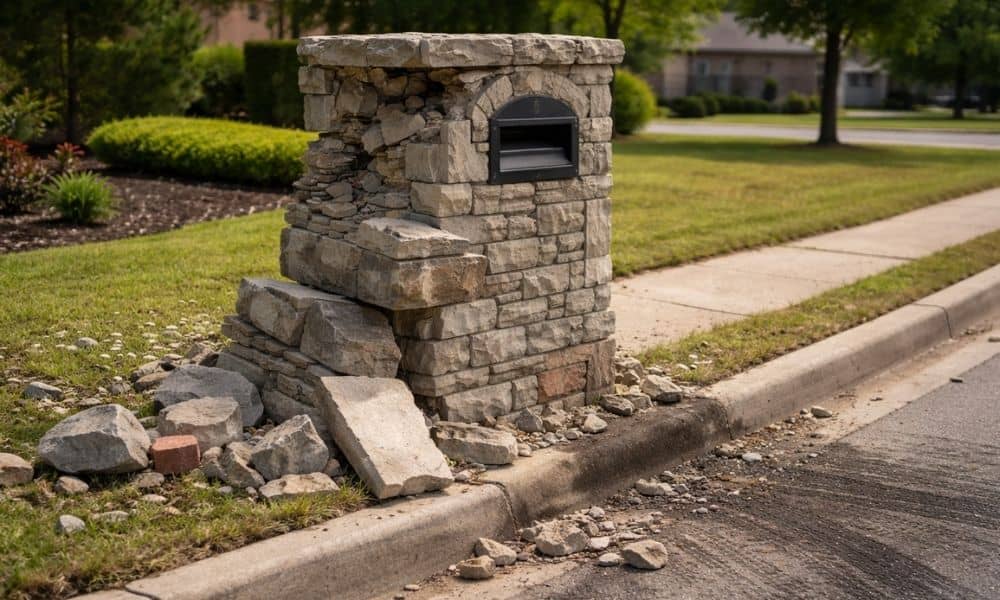
A recent crash video started making rounds online. In the clip, a delivery truck drifts too close to the curb and slams straight into a roadside mailbox. Within seconds, the structure explodes into pieces. The driver steps out. The homeowner runs outside. The comment section fills up fast. Most people watched it and thought the same thing: What if that happened at my house? If you own a stone mailbox, that question matters more than you think.
Because while stone looks strong and permanent, not every build can handle real-world impact.
Why Mailbox Impacts Happen More Than You Think
First, look at how much traffic has changed.
Huntsville keeps growing. New neighborhoods pop up every year. Construction trucks move through residential streets daily. On top of that, delivery vans stop at almost every driveway. Add teenage drivers, tight turns, and rainy evenings, and suddenly your curbside structure faces more risk than ever.
Even small mistakes cause damage. A side mirror clips the edge. A truck backs up too far. A distracted driver drifts six inches too wide. That’s all it takes.
Since your stone mailbox sits right beside the road, it stands in the direct line of danger.
Not All Stone Mailboxes Are Built the Same
Here’s the truth most homeowners don’t realize:
Two stone mailboxes can look identical on the outside — yet perform completely differently during an impact.
The difference hides inside the structure.
Some builders stack stone veneer over a lightweight frame. They skip reinforcement. They pour a shallow base. The mailbox looks solid. However, it lacks real structural support. In a crash, this type often shatters or tips over completely.
On the other hand, a properly engineered stone mailbox includes a deep concrete footing, a solid concrete block core, steel reinforcement bars, and an anchored base tied into the footing. This design distributes force. Instead of collapsing instantly, it resists movement.
So when someone asks, “Isn’t stone always strong?” the answer depends on how the builder constructed it.
What Happens During an Impact?
Let’s break it down into real-world situations.
During minor contact, a slow-moving vehicle clips the edge. A well-built structure may show surface damage. However, the core stays intact. A weak build, by contrast, may crack at the base or shift off center.
In a moderate collision, a vehicle hits at neighborhood speed. Now force travels through the entire structure. If reinforcement exists, the mailbox absorbs some of that energy. If not, the base may split, causing the entire column to fall.
In a direct hit, even reinforced structures may suffer damage. Still, strong construction prevents total destruction and reduces debris spread.
Therefore, strength does not mean indestructible. It means controlled failure instead of complete collapse.
The Safety Question Most People Ignore
Now here’s something few homeowners consider.
If a structure stands too rigid and too close to the roadway, it can cause serious vehicle damage. In some areas, mailbox placement rules require specific setbacks or breakaway features.
While a stone mailbox should feel solid, it also needs smart placement.
A professional builder considers distance from the pavement edge, visibility to approaching drivers, height and proportion, and stability without overexposure.
Balance matters. You want durability without creating unnecessary hazards.
Signs Your Current Stone Mailbox May Not Be Impact-Ready
Take a quick look at your structure.
Does it sit directly on soil with no visible concrete base? Does it sound hollow when you tap it? Does it lean slightly toward the road? Does it sit extremely close to passing traffic?
If you answered yes to any of these, your mailbox may rely more on appearance than strength.
Many older builds focused on curb appeal alone. At the time, traffic stayed lighter. However, conditions change.
Designing a Stone Mailbox That Handles Real-World Force
When built correctly, a stone mailbox becomes more than decoration. It becomes a small structural system.
A reinforced concrete footing extends below surface level and prevents shifting during lateral force. A concrete block core inside the stone shell provides internal mass. Steel reinforcement bars tie the entire structure together. During impact, they hold pieces in place and prevent full separation.
Proper setback from the roadway matters just as much as structure. Even the strongest mailbox will struggle if placed inches from traffic lanes.
Together, these elements create a balanced build — one that resists force without becoming unsafe.
What About Insurance?
After a crash, most drivers carry liability insurance that covers property damage. However, documentation helps.
If your stone mailbox was professionally installed, you can show construction details and cost records. This simplifies claims. On the other hand, if a poorly built mailbox collapses easily, repair may cost less — yet it leaves you rebuilding again in a few years.
Strong design often protects both structure and investment.
Why This Conversation Matters Now
That viral crash video hit hard because it felt sudden. Yet mailbox impacts happen every year.
As Huntsville continues to grow, roadside structures face more exposure. Delivery frequency rises. Traffic volume increases. Construction vehicles pass through neighborhoods daily.
Therefore, curbside design deserves more thought than ever before.
A stone mailbox should not just look impressive. It should perform when real life tests it.
Final Thought: Built for Beauty or Built for Impact?
Curb appeal matters. However, durability matters more when a two-ton vehicle drifts off course.
If you’re unsure how your stone mailbox was built, now is the time to find out. A quick structural assessment can reveal whether it rests on solid engineering or simple surface design.
The viral video shocked thousands of viewers. Still, you don’t need a crash to discover weak construction.
Build for beauty, yes. But build for impact, too.
Because when the unexpected happens, structure tells the real story.