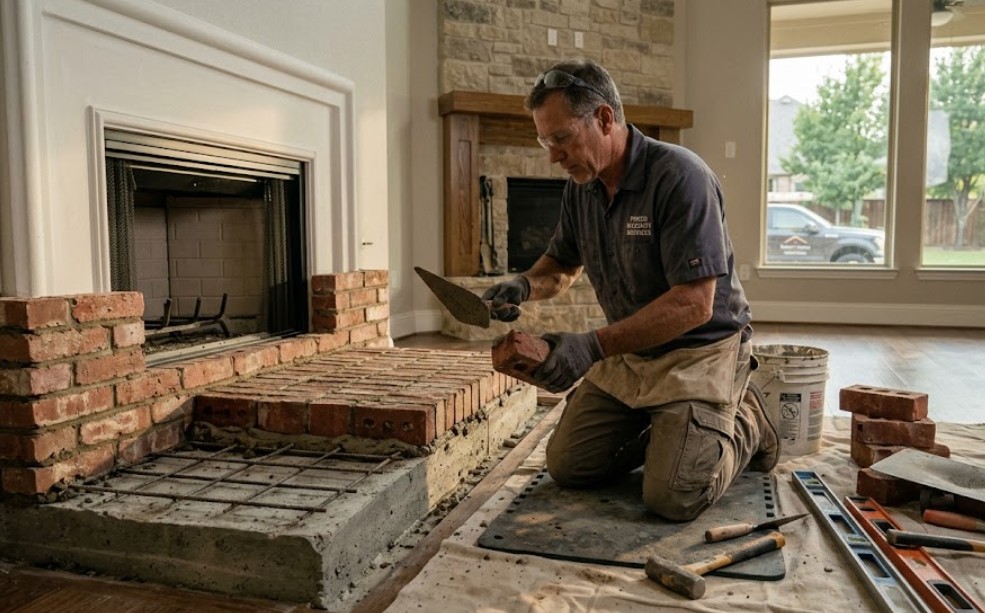
If you walk through neighborhoods like Newman Village or Stonebriar, you see a common theme. People here value their homes. They want materials that look good and stay that way. In North Texas, the center of that home life often sits right at the fireplace.
A well-built brick hearth is more than a place to set your fireplace tools. It is a structural element that has to deal with the specific environmental quirks of Frisco. If you are a homeowner or a property manager, understanding these local challenges is the difference between a project that lasts decades and one that cracks in three years.
The Frisco Soil Factor: Shifting Ground and Masonry
Frisco sits on expansive clay soil. If you have lived here through a few seasons, you know exactly what that means. The ground swells when we get those heavy spring rains and shrinks during our triple-digit August dry spells.
This movement is the primary cause of masonry failure in our region. A brick hearth is heavy. If the foundation or the sub-floor beneath it isn’t properly reinforced, the shifting clay will eventually cause the bricks to pull away from the wall or develop “step cracks” in the mortar.
Temperature Extremes and Brick Resilience
We don’t just deal with shifting ground. We deal with thermal shock. One day it is eighty degrees, and the next, a North Texas blue norther drops the temperature by forty degrees in a few hours.
Bricks are porous. They absorb a tiny amount of moisture. When that moisture freezes and thaws rapidly, it can cause the face of the brick to flake off—a process called spalling. Professional masonry involves selecting the right type of brick that can handle these rapid changes without losing its structural integrity.
Navigating HOA and Local Building Standards
Most Frisco subdivisions have strict Homeowners Association guidelines. They usually specify everything from the percentage of masonry on your home to the specific color of the mortar.
- Mortar Matching: If you are doing a repair or an addition, getting the mortar right is the hardest part. It isn’t just “grey.” We use custom sand ratios to match the existing masonry so the new work doesn’t look like a patch.
- Building Codes: The City of McKinney and Frisco have clear rules about hearth dimensions and clearance from combustible materials. You can’t just stack bricks; you have to ensure the air gaps and firebricks meet modern safety standards.
Choosing the Right Materials for Your Hearth
While “red brick” is the classic Texas look, modern Frisco homes are moving toward a variety of textures and colors.
Hand-Molded Bricks
These offer a slightly irregular, historic look that fits perfectly in some of our more established neighborhoods. They give the home a sense of age and permanence that machine-cut bricks often lack.
King-Size Bricks
In many newer Frisco builds, you’ll see king-size bricks. They are larger than standard bricks, which means fewer mortar lines. This creates a cleaner, more contemporary look for a brick hearth while still providing the durability of traditional masonry.
Common Signs Your Masonry Needs Professional Care
You don’t need to be a contractor to know when something is wrong. You just need to look for a few red flags.
- Loose Mortar: If you can scrape the mortar out with a fingernail, it’s failing.
- Gaps at the Wall: If you see a sliver of space between your hearth and the wall, the structure is settling.
- Cracked Bricks: A single cracked brick might be a fluke. A line of them is a structural sign.
Why DIY Masonry Fails in North Texas
It’s tempting to grab a bag of premix from a big-box store and try to fix a crack yourself. The problem is that most retail mortars are too hard. In a place where the ground moves, you need a mortar that is slightly more flexible than the brick itself. If the mortar is too rigid, the brick will crack instead of the joint.
Investing in Long-Term Value
A professional masonry project is an investment in your property’s value. Whether you are a builder or a homeowner, the quality of the brickwork tells a story about the rest of the house.
- Durability: A properly built hearth should outlast the roof, the HVAC, and the people living in the house.
- Efficiency: Solid masonry holds heat. It acts as a thermal mass, slowly releasing warmth into the room long after the fire has gone out.
- Aesthetics: There is a reason brick has been the standard for thousands of years. It never goes out of style.
Building with the Future in Mind
A hearth is the center of the home for a reason. It’s where people gather when the weather turns cold. In Frisco, where the elements are always testing our structures, you want something built by people who know the local terrain.
If you are noticing changes in your masonry or planning a new project, take the time to do it right. Good brickwork is about more than just the bricks you see; it’s about the foundation you don’t. We are here to help you make sure your home stays as solid as the day it was built.