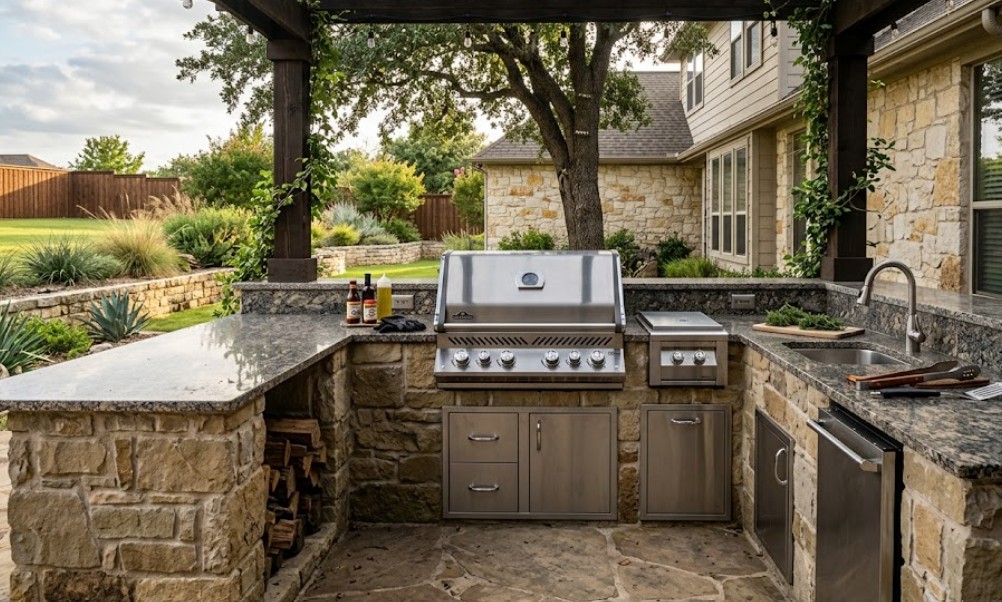
If you live in North Texas, you know the ground is rarely still. The black land prairie soil we build on acts like a living thing—expanding when it rains and shrinking until the earth cracks during a dry August. For a homeowner, this movement is the primary enemy of any stone or brick project.
Building an outdoor kitchen in this environment isn’t just about picking out a grill and some pretty stone. It’s about engineering a structure that won’t settle, lean, or crack when the soil decides to move. In a fast-growing area where property values are high, doing it right the first time is the only way to protect your investment.
The Foundation: Beating the Black Clay
Most backyard failures happen because the person building them treated the project like they were working on solid rock. In our area, you have to assume the ground will shift.
A proper masonry build starts deep. We don’t just lay stone on a thin bed of sand. To handle the weight of a full stone island and heavy granite tops, you need a reinforced concrete footer. This acts like a raft, spreading the weight and resisting the upward pressure of wet clay. If your builder skips this, you’ll see your counter joints separating within two years.
Managing Drainage and Runoff
We get those massive North Texas thunderstorms that drop three inches of rain in an hour. If your backyard isn’t graded correctly, that water pools against your masonry.
Water trapped under a stone patio or against a kitchen island softens the base. We design every project with a specific slope to ensure water moves away from your home’s foundation. It’s a small detail that prevents massive structural headaches later.
Material Choices for the Texas Sun
The sun here is a different beast. It bleaches cheap materials and makes dark surfaces hot enough to cook on. When choosing stone for your backyard, you have to think about thermal mass.
- Native Limestone: It’s a classic look for local architecture. It stays relatively cool but is porous. It needs a high-quality sealer to prevent grease and wine stains from becoming permanent.
- Granite Countertops: Nothing beats granite for an outdoor kitchen. It handles the UV rays without fading and is tough enough to withstand a heavy cast-iron skillet being dropped on it.
- Brick Accents: Brick is incredibly stable and matches many of the traditional home styles in neighborhoods like Stonebriar or Newman Village.
Navigating HOA and City Guidelines
In this part of the county, HOAs are diligent. They want to ensure that any new structure matches the aesthetic of the neighborhood.
Most local guidelines require masonry to be “four-sided,” meaning you can’t have an exposed wood or metal frame on the back of your kitchen island. Using natural stone or brick that matches your home’s exterior isn’t just a style choice; it’s often a requirement for approval. We help navigate these rules so you don’t end up with a violation letter after the stone is already set.
Thinking About Utilities
An outdoor kitchen is essentially a small house addition. You’re dealing with gas lines, electricity, and sometimes plumbing.
In North Texas, these lines need to be buried deep enough to avoid damage from shifting soil. We also build in ventilation panels. These are mandatory for safety—if a gas leak occurs inside a stone cabinet, the gas needs a way to escape so it doesn’t pool and create a hazard.
Why Craftsmanship Outlasts “Kits”
You can buy a prefabricated kitchen kit at a big-box store, but they rarely last in our climate. Those kits use thin metal studs and synthetic “stick-on” stone. The heat from the grill and the humidity from our summers eventually cause the adhesive to fail, and the stones start falling off like scales.
Real masonry involves hand-laying every piece. A skilled mason looks at the “grain” of the stone and ensures the mortar joints are tight. This creates a solid, monolithic structure that handles the heat of the grill and the cold snaps of February without flinching.
The Long-Term Value of Stone
When you look at the local real estate market, “outdoor living” is consistently at the top of the list for buyers. They want a space that feels like an extension of the house.
A well-built stone feature adds tangible value. It’s a sign that the property has been maintained with high-quality materials. Because stone is fire-resistant and pest-proof, it’s one of the few parts of your landscaping that won’t need to be replaced in a decade. It only gets better as the stone weathers and settles into the landscape.
Maintenance for Our Region
While masonry is tough, it isn’t “set it and forget it.”
- Seal Every Few Years: Especially with porous stones like Austin Chalk or Limestone. A good sealer keeps moisture from getting into the pores.
- Clear the Weep Holes: If you have a stone wall, make sure the drainage holes aren’t clogged with mulch or dirt.
- Inspect the Mortar: If you see small “hairline” cracks, get them filled early. It’s a cheap fix that prevents water from getting behind the stone and causing a larger break.
Creating a Functional Space
Don’t build more than you need. A massive kitchen that takes up the entire yard can feel cramped. We focus on the “work triangle”—the distance between your grill, your prep area, and your cold storage.
If you’re planning a project, think about how you actually live. Do you need a full bar for entertaining, or just a solid place to sear steaks for the family? A smaller, perfectly executed masonry project is always better than a large, poorly built one.
If you have questions about how a specific stone will hold up on your lot or how to handle a tricky slope in your backyard, it helps to talk to someone who has worked with this soil before. Every yard is different, but the rules of good masonry stay the same. Reach out if you want to discuss how to make your backyard more functional for the long haul.