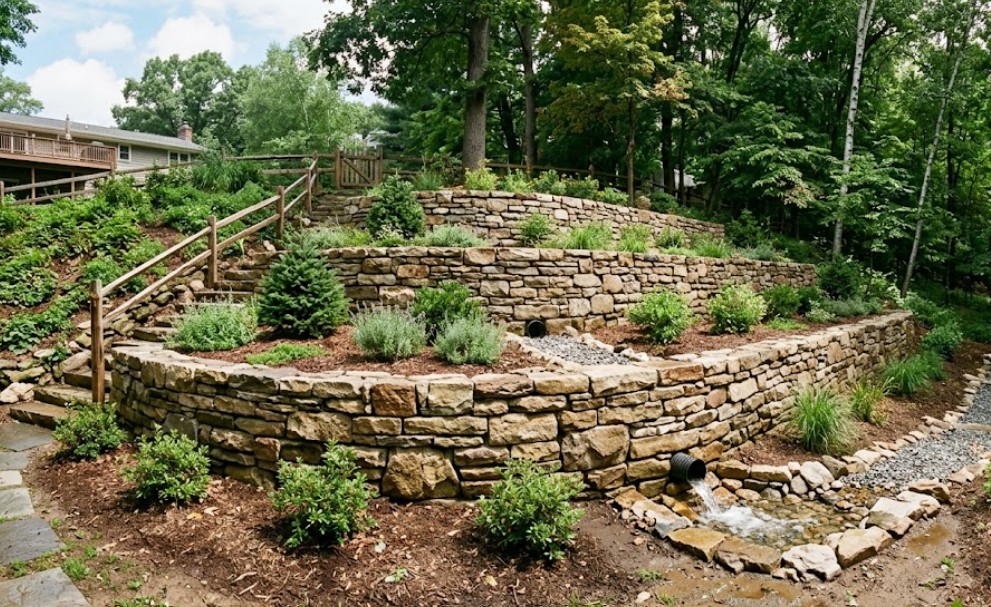
If you live anywhere near Monte Sano or the rolling hills of Madison County, you know our landscape is beautiful but challenging. We don’t just have “dirt” here. We have a mix of limestone shelf and heavy, expansive red clay. This combination creates a unique set of problems for anyone trying to level a yard or hold back a slope. Visit the website.
In North Alabama, masonry isn’t just about making a flower bed look nice. It’s often a battle against gravity and water. If you’ve lived here through a few spring seasons, you’ve seen what happens when a poorly built wall meets a week of relentless rain. It doesn’t just lean; it fails.
The Science of the “Huntsville Shift”
Our red clay acts like a sponge. When it gets saturated, it gains incredible weight and exerts massive pressure on anything in its way. This is known as hydrostatic pressure.
Most failed projects we see in the area stem from a single mistake: the builder treated the soil like it was static. In reality, that hill behind your house is trying to move downward every time it pours. Without a structure designed to handle that specific force, you’re just putting a clock on when the bricks will start to crack.
Why a Retaining Wall Fails (And How to Fix It)
A retaining wall is essentially an engineered dam for soil. If you build it without a plan for water, the water will eventually find its own way out—usually by pushing your wall over.
Drainage is Not Optional
Water must have a path of least resistance. We use a combination of gravel backfill and “weep holes”—small gaps in the masonry that allow moisture to escape from behind the stone. Without these, the pressure builds up until the mortar joints snap.
Foundation Depth
Because of our freeze-thaw cycles in January and February, your wall needs a footing that sits below the frost line. If the foundation is too shallow, the ground will heave during a freeze, lifting the wall and causing those jagged, “stair-step” cracks that are so common in local neighborhoods.
Choosing Materials for the Tennessee Valley
Huntsville architecture ranges from the historic brick of Twickenham to the modern stone veneers in new developments. Your choice of material should reflect the style of your home while standing up to the elements.
- Natural Limestone: It’s local, it’s beautiful, and it’s incredibly heavy. It’s perfect for structural work because its weight helps it stay put.
- Fired Clay Brick: A classic Southern choice. It matches the traditional look of many local HOAs and handles our humidity better than concrete blocks.
- Modular Blocks: These are great for purely functional areas, but they lack the unique character and long-term “heft” of real stone.
Navigating Local Building Codes and HOAs
If you are building a wall higher than four feet, the City of Huntsville generally requires an engineered plan. This isn’t just bureaucracy; it’s a safety measure. A wall that tall holding back a slope carries enough weight to cause serious property damage if it collapses.
Furthermore, many neighborhoods—especially in areas like The Ledges or McMullen Cove—have strict rules about which stones you can use. They want a cohesive look. We often spend as much time matching mortar colors and stone textures as we do actually laying the material. It has to look like it has always been part of the landscape.
The Long-Term Value of Masonry
When you drive through the older parts of town, you see stone walls that have been standing since the 1940s. They haven’t survived by luck. They survived because a mason took the time to set a deep foundation and manage the water.
- Erosion Control: A solid wall stops your backyard from washing into your neighbor’s pool.
- Usable Space: By leveling off a slope, you create flat ground for patios, play areas, or gardens.
- Curb Appeal: Nothing says “permanence” like hand-laid stone. It signals to future buyers that the property was cared for by professionals.
Why Craftsmanship Matters
It’s easy to find a cheap bid for a landscape project. But masonry is one of the few things where the “budget” option usually ends up costing double in the long run.
A real mason doesn’t just stack rocks. They look at the “grain” of the stone. They ensure the weight is distributed so the structure is self-supporting even without the mortar. They understand that the most important parts of the project—the drainage pipes and the gravel base—are the parts you’ll never see once the job is finished.
Maintaining Your Stone Features
Even the toughest wall needs a check-up. We tell homeowners to walk their property line twice a year.
- Clear the Weeps: Make sure grass or mulch hasn’t plugged up the drainage holes.
- Watch the Grade: If you see “sinkholes” forming behind the wall, water is likely bypassing your drainage system.
- Check the Mortar: If the mortar is turning to sand, it’s time for tuckpointing. Replacing the “glue” is much cheaper than replacing the stone.
Building for the Next Generation
In an era of “fast” construction, masonry remains a slow, deliberate art. It’s about building things that stay put. Whether you’re trying to save a sliding hillside or just want to define your property line with something more substantial than a fence, stone is the answer.
Don’t wait until a small crack becomes a collapsed wall. Understanding the relationship between our local red clay and the stone we put on top of it is the first step toward a backyard that lasts. If you’re seeing signs of movement in your yard, it’s worth having a conversation about how to stabilize it properly. We’re always here to help you figure out a plan that fits your home’s style and the valley’s unique geography.